Evaluation of the antimicrobial effect of Uncaria tomentosa (Willd. ex Schult.) DC. extracts against bacterial and fungal strains of clinical and environmental importance
DOI:
https://doi.org/10.67321/na3r0r1aKeywords:
antimicrobial resistance, Uncaria tomentosa, plant extracts, antimicrobial activity, minimum inhibitory concentration, solventsAbstract
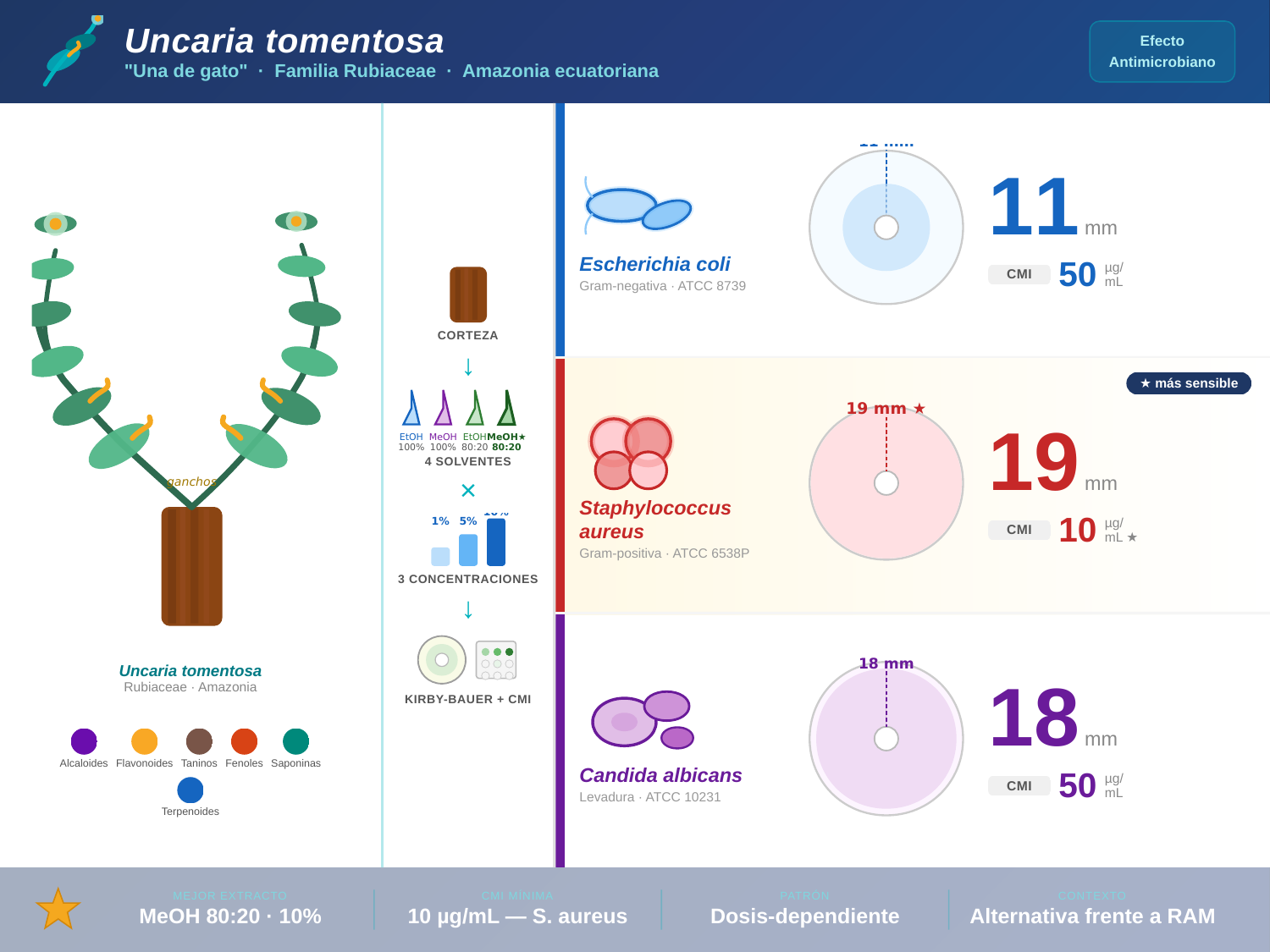
Antimicrobial resistance (AMR) is a growing global threat driving the search for plant-based therapeutic alternatives. Uncaria tomentosa (Willd. ex Schult.) DC. (cat's claw), an Amazonian liana of the Rubiaceae family, has a rich phytochemical composition with documented antimicrobial activity. We evaluated the antimicrobial effect of dry-bark extracts obtained with four solvents (EtOH 100%, MeOH 100%, EtOH 80:20, MeOH 80:20) at three concentrations (1%, 5%, 10% w/v) against Escherichia coli ATCC 8739, Staphylococcus aureus ATCC 6538P, and Candida albicans ATCC 10231, using phytochemical screening, disk diffusion (Kirby-Bauer), and broth microdilution (MIC). Data were analyzed by multifactorial ANOVA with Tukey post hoc test. Screening confirmed alkaloids, flavonoids, tannins, phenols, saponins, and terpenoids in all extracts, with greater intensity in 80:20 mixtures. Inhibition zones were dose-dependent; MeOH 80:20 at 10% yielded the largest zones against S. aureus (19 mm) and C. albicans (18 mm). The lowest MIC (10 µg/mL) was obtained against S. aureus with MeOH 100%, MeOH 80:20, and EtOH 80:20. ANOVA revealed significant effects of solvent, concentration, microorganism, and interactions (p < 0.001–0.022). U. tomentosa is a promising source of natural antimicrobial agents, particularly effective against Gram-positive bacteria.
Downloads
References
Aguilar, G. R., et al. (2022). Global mortality associated with 33 bacterial pathogens in 2019. The Lancet, 400(10369), 2221–2248.
Batiha, G., et al. (2020). Uncaria tomentosa (Willd. ex Schult.) DC.: A Review on Chemical Constituents and Biological Activities. Applied Sciences, 10(8), 2668. https://doi.org/10.3390/app10082668
Blanck, J., Huebner, T., Rolls, A., Cornell, J., & Hwang, C. (2022). Comprehensive Review of the Components in Cat's Claw (Uncaria tomentosa) and Their Antibacterial Activity. AppliedChem, 2(4), 174–211. https://doi.org/10.3390/appliedchem2040013
Ccahuana-Vásquez, R. A., et al. (2007). Antimicrobial Activity of Uncaria tomentosa Against Oral Human Pathogens. Brazilian Oral Research, 21(1), 46–50.
Famuyide, I. M., et al. (2019). Antibacterial and Antibiofilm Activity of Acetone Leaf Extracts of Nine South African Eugenia and Syzygium Species. BMC Complementary and Alternative Medicine, 19(1), 1–12.
Jadimurthy, R., et al. (2023). Phytochemicals as Invaluable Sources of Potent Antimicrobial Agents to Combat Antibiotic Resistance. Life, 13(3), 734.
Moraes, R., et al. (2015). Antifungal activity of Uncaria tomentosa against resistant non-albicans Candida isolates. Phytomedicine, 22(2), 189–195.
Moraes, R., et al. (2016). In vitro synergism of a water insoluble fraction of Uncaria tomentosa combined with fluconazol and terbinafine. Phytomedicine, 23(2), 189–195.
Montiel, D. G., et al. (2023). Influence of the Extraction Method on the Polyphenolic Profile and the Antimicrobial Activity. Molecules, 28(7), 2956.
Navarro-Hoyos, M., et al. (2018). Polyphenolic Composition and Antioxidant Activity of Aqueous and Ethanolic Extracts from Uncaria tomentosa. Antioxidants, 7(9), 65.
Navarro-Hoyos, M., et al. (2019). Polyphenolic Composition and Antioxidant Activity of Uncaria tomentosa Commercial Bark Products. Antioxidants, 8(9), 339.
Oliveira, M., et al. (2024). An Overview of the Recent Advances in Antimicrobial Resistance. Microorganisms, 12(2), 407.
Sánchez Hernández, E., et al. (2022). Bark Extract of Uncaria tomentosa L. for the Control of Phytopathogenic and Clinically Relevant Bacteria. Plants, 11(19), 2574. https://doi.org/10.3390/plants11192574
Sena, C. M., et al. (2025). Effects of Uncaria tomentosa and Uncaria guianensis Aqueous Extract on Enzyme Activity. Molecules, 30, 123.
Downloads
Recibido
Aceptado
Published
Issue
Section
Categories
License
Copyright (c) 2026 Los autores

This work is licensed under a Creative Commons Attribution 4.0 International License.
Cualquier usuario o lector es libre de:
-
Compartir: Copiar y redistribuir el material en cualquier medio o formato.
-
Adaptar: Remezclar, transformar y construir a partir del material para cualquier propósito, incluso comercial.
Bajo la siguiente condición estricta:
-
Reconocimiento (Atribución): Se debe otorgar el crédito correspondiente de manera adecuada. Quien utilice el material debe citar a los autores originales, mencionar a Horizontes Amazónicos como el medio de publicación original, proporcionar un enlace a la licencia e indicar claramente si se ha realizado algún cambio sobre el trabajo original.