
Characterization of Wildlife Biodiversity in the Yanacocha Biopark
DOI:
https://doi.org/10.67321/2gxa2f16Keywords:
biodiversity, wildlife, illegal trafficking, rescue center, conservation, Ecuadorian AmazonAbstract
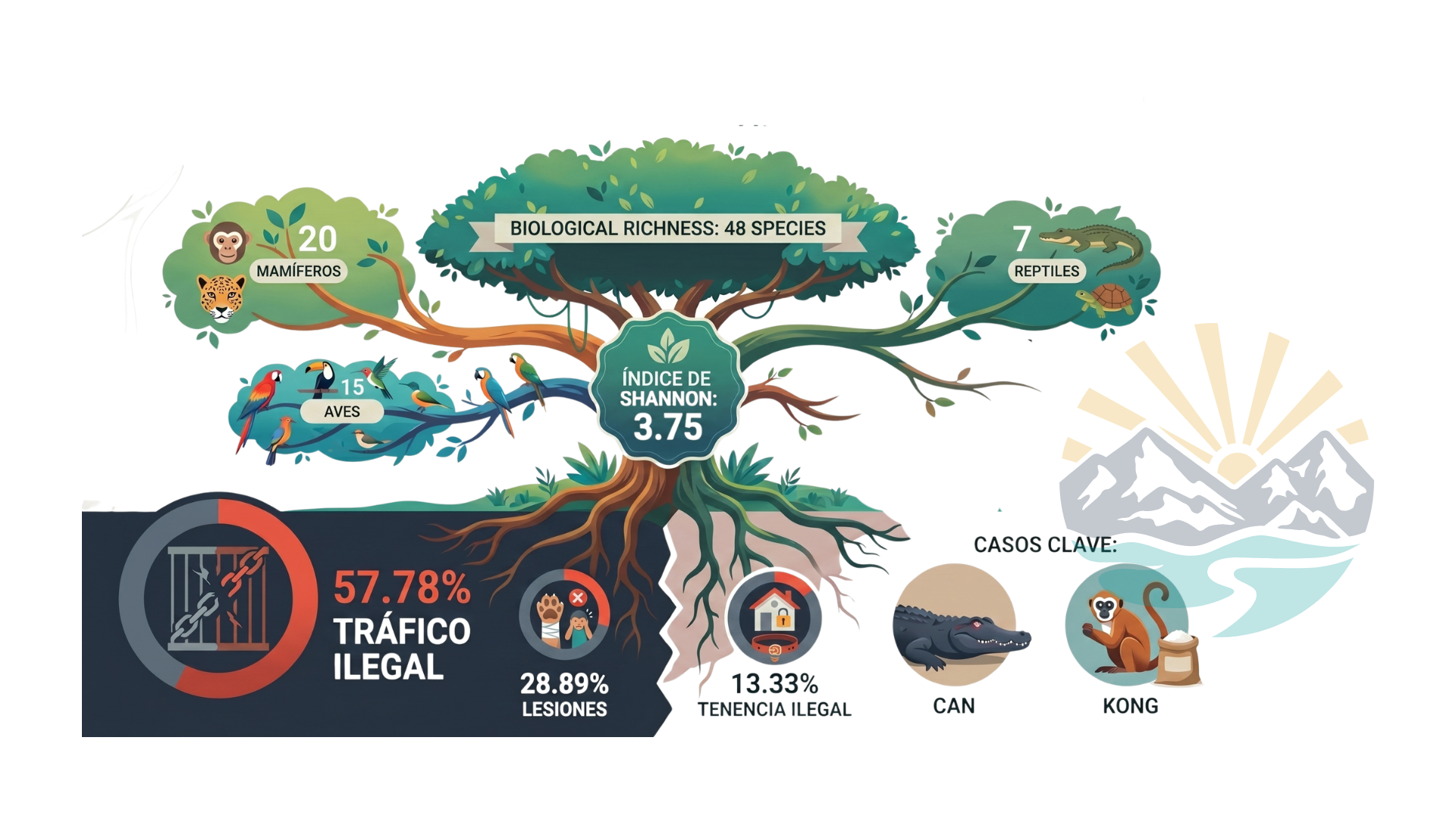
Biodiversity loss and illegal wildlife trafficking constitute critical threats to Ecuadorian Amazonian ecosystems, where rescue centers represent key spaces for the care, documentation, and conservation of species affected by human activities. This study aimed to characterize the wildlife biodiversity of the Yanacocha Biopark, located at kilometer 3.5 of the Puyo–Tena road, Pastaza Province, Ecuador, through systematic species recording, analysis of diversity indices, and identification of the main causes of animal intake. Four weekly direct observation visits were conducted during January 2026, complemented by a semi-structured interview with the biopark owner. A total of 48 species across five taxonomic groups were recorded: mammals (20 spp., 41.67%), birds (15 spp., 31.25%), reptiles (7 spp., 14.58%), fish (5 spp., 10.42%), and amphibians (3 spp., 6.25%). Calculated indices indicated high diversity (H' = 3.75), low dominance (d = 0.22), and equitable distribution among groups (J' = 0.97). Illegal trafficking constituted the main cause of intake (57.78%), followed by rescue due to injury or vulnerability (28.89%) and illegal domestic possession (13.33%). Results demonstrate that the Yanacocha Biopark plays a relevant role in the ethical care of affected wildlife and in environmental education, although its direct contribution to population conservation is limited, reinforcing the need to strengthen regulatory frameworks and systematic registration systems in Amazonian rescue centers.
Downloads
References
Beaulieu, M. (2025). Rehabilitating wild animal welfare: A focus on veterinary rescue and rehabilitation interventions. Research in Veterinary Science. Elsevier B.V. https://doi.org/10.1016/j.rvsc.2025.105582
Cardoso, P., et al. (2021). Scientists' warning to humanity on illegal or unsustainable wildlife trade. Biological Conservation, 247, 109341. https://doi.org/10.1016/j.biocon.2021.109341
Centro Jambatu. (2024). Reporte de impacto sobre conservación ex situ de anfibios amenazados en cautiverio en Ecuador (incluye especies críticamente en peligro). https://files.stlzoo.org/production/documents/WildCare-Institute/Ecuador-Impact-Report24-241016.pdf
Costa, M. M., Pinto da Cunha, N., Hagnauer, I., & Venegas, M. (2024). A retrospective analysis of admission trends and outcomes in a wildlife rescue and rehabilitation center in Costa Rica. Animals, 14(1), Article 51. https://doi.org/10.3390/ani14010051
Crespo-Gascón, S., Solórzano, C. B., & Guerrero-Casado, J. (2022). Tráfico nacional de fauna silvestre y especies amenazadas: Un estudio descriptivo en Manabí (Ecuador). La Granja: Revista de Ciencias de la Vida, 35(1), 33–44. https://doi.org/10.17163/lgr.n35.2022.03
De la Torre, S., & Morelos-Juárez, C. (2022). Primate Conservation Efforts and Sustainable Development Goals in Ecuador, Combining Research, Education and Capacity Building. Animals. MDPI. https://doi.org/10.3390/ani12202750
Fukushima, C. S., Tricorache, P., Toomes, A., Stringham, O. C., & Marsden, S. J. (2021). Challenges and perspectives on tackling illegal wildlife trade. Biological Conservation, 263, 109342. https://doi.org/10.1016/j.biocon.2021.109342
Guénard, B., Hughes, A. C., Lainé, C., Cannicci, S., Russell, B. D., & Williams, G. A. (2025). Limited and biased global conservation funding means most threatened species remain unsupported. Proceedings of the National Academy of Sciences of the United States of America, 122(9). https://doi.org/10.1073/pnas.2412479122
Hughes, A., Auliya, M., Altherr, S., Scheffers, B., Janssen, J., Nijman, V., … Edwards, D. P. (2023a). Determining the sustainability of legal wildlife trade. Journal of Environmental Management. Academic Press. https://doi.org/10.1016/j.jenvman.2023.117987
Hughes, L. J., Morton, O., Scheffers, B. R., & Edwards, D. P. (2023b). The ecological drivers and consequences of wildlife trade. Biological Reviews, 98(3), 775–791. https://doi.org/10.1111/brv.12929
Johnston, A., Matechou, E., & Dennis, E. B. (2023b). Outstanding challenges and future directions for biodiversity monitoring using citizen science data. Methods in Ecology and Evolution, 14(1), 103–116. https://doi.org/10.1111/2041-210X.13834
Kleemann, J., Koo, H., Hensen, I., Mendieta-Leiva, G., Kahnt, B., Kurze, C., … Fürst, C. (2022). Priorities of action and research for the protection of biodiversity and ecosystem services in continental Ecuador. Biological Conservation. Elsevier Ltd. https://doi.org/10.1016/j.biocon.2021.109404
Macdonald, D. W., Harrington, L. A., Moorhouse, T. P., & D’Cruze, N. (2021). Trading animal lives: Ten tricky issues on the road to ending wildlife trade. BioScience, 71(12), 1232–1242. https://doi.org/10.1093/biosci/biab035
Ortega-Andrade, H. M., Rodes Blanco, M., Cisneros-Heredia, D. F., Guerra Arévalo, N., López de Vargas-Machuca, K. G., Sánchez-Nivicela, J. C., Armijos-Ojeda, D., Cáceres Andrade, J. F., Reyes-Puig, C., Quezada Riera, A. B., Szekely, P., Rojas Soto, O. R., Szekely, D., Guayasamin, J. M., & Yánez Muñoz, M. H. (2021). Red List assessment of amphibian species of Ecuador: A multidimensional approach for their conservation. PLoS ONE, 16(5), e0251027. https://doi.org/10.1371/journal.pone.0251027
Paterson, J. E., Carstairs, S., & Davy, C. M. (2021). Population-level effects of wildlife rehabilitation and release vary with life-history strategy. Journal for Nature Conservation, 61, Article 125983. https://doi.org/10.1016/j.jnc.2021.125983
Prosekov, A., Kuznetsov, A., Rada, A., & Ivanova, S. (2020). Methods for Monitoring Large Terrestrial Animals in the Wild. Forests, 11(8), 808. https://doi.org/10.3390/f11080808
Rivera, S. N., Knight, A., & McCulloch, S. (2021). Surviving the wildlife trade: Reforming the management of confiscated animals. Animals, 11(2), 439. https://doi.org/10.3390/ani11020439
Rose, P. E., & Lewton, J. (2025). Key Concepts for Enhancing Zoo Animal Welfare: Coping, Comfort, Choice, Control, Challenge, and Compassion. Journal of Applied Animal Welfare Science, 28(3), 497–514. https://doi.org/10.1080/10888705.2024.2440891
Stephenson, P. J., & Carbone, G. (2021). Guidelines for planning and monitoring corporate biodiversity performance. International Union for Conservation of Nature. https://doi.org/10.2305/IUCN.CH.2021.05.en
Tallo-Parra, O., Salas, M., & Manteca, X. (2023). Zoo Animal Welfare Assessment: Where Do We Stand? Animals. MDPI. https://doi.org/10.3390/ani13121966
Villalba-Briones, R., Mendoza, P., & Garcés, D. (2024). Synergistic threats to wildlife in Ecuador. Diversity, 16(8), 490. https://doi.org/10.3390/d16080490
Zhao, Y., Liu, J., Wang, F., Zhang, Y., & Ma, Z. (2025). Targeted conservation actions are required to save species from extinction. Biological Conservation, 310. https://doi.org/10.1016/j.biocon.2025.111340
Zwerts, J. A., et al. (2021). Methods for wildlife monitoring in tropical forests: Comparing human observations, camera traps and passive acoustic sensors. Conservation Science and Practice. https://doi.org/10.1111/csp2.568
Downloads
Recibido
Aceptado
Published
Issue
Section
Categories
License

This work is licensed under a Creative Commons Attribution 4.0 International License.
Cualquier usuario o lector es libre de:
-
Compartir: Copiar y redistribuir el material en cualquier medio o formato.
-
Adaptar: Remezclar, transformar y construir a partir del material para cualquier propósito, incluso comercial.
Bajo la siguiente condición estricta:
-
Reconocimiento (Atribución): Se debe otorgar el crédito correspondiente de manera adecuada. Quien utilice el material debe citar a los autores originales, mencionar a Horizontes Amazónicos como el medio de publicación original, proporcionar un enlace a la licencia e indicar claramente si se ha realizado algún cambio sobre el trabajo original.