Female Leadership in the Sarayaku Community and Its Construction in the Amazonian Context
DOI:
https://doi.org/10.67321/g0mhb471Keywords:
Female leadership, Sarayaku community, Territorial defense, ExtractivismAbstract
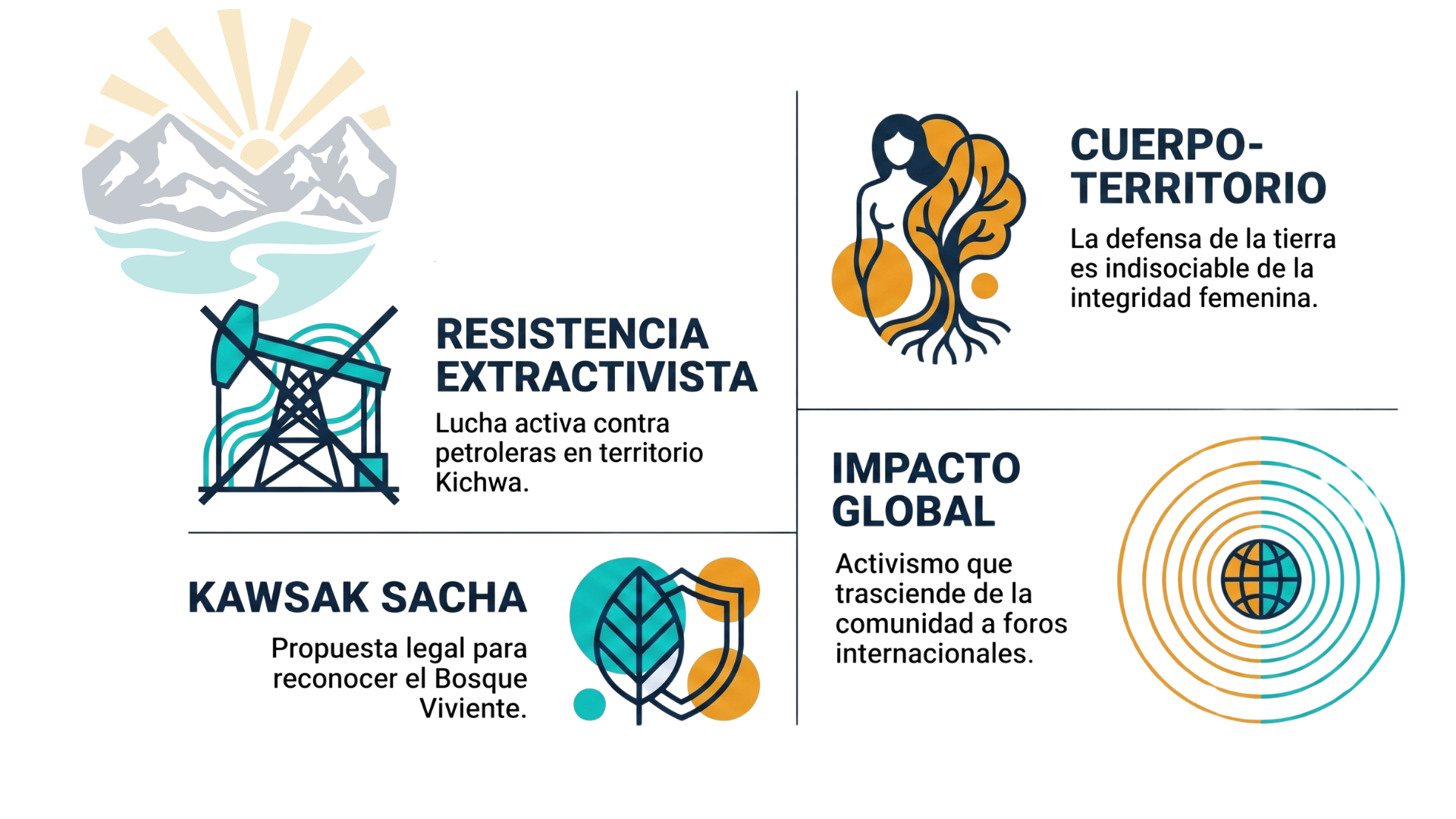
The case studied occurred in the Amazonian community of Sarayaku, in Ecuador, and addressed indigenous female leadership in a context traditionally dominated by patriarchal structures. The study focused on how Sarayaku women have managed to build and consolidate their leadership in the public and private spheres, overcoming cultural, social, and political barriers. It sought to document the forms of women's participation in the community, analyzing gender roles and changes in the internal social structure. An ethnographic approach was applied, with fieldwork and interviews with Sarayaku women leaders, allowing a deep understanding of local social and political dynamics. The main findings showed that female leadership emerged from a constant struggle for visibility and equity, with women being key in the defense of territory and culture. Despite difficulties, women found alternative spaces such as activism and community leadership. This experience highlights how indigenous women, historically marginalized, have become central actors in the defense of their rights and territory. It contributes to the study of indigenous movements and gender leadership, providing a model of empowerment and resistance.
Downloads
References
Barrow, S., Ulfe, M. E., Atakav, E., Vergara, R., Chicmana, V., Pelikan, K., & Omiaasec, The Young Women Of. (2024). Women of Influence: interdisciplinary participatory approaches to understanding female leadership in the Peruvian Amazon. New Area Studies. doi:10.37975/nas.63
Cárdenas, L. P. (2018). Participación política de mujeres indígenas en tiempos de la Revolución Ciudadana. 28, 61–72. doi:10.24275/uam/izt/dcsh/alteridades/2018v28n55/perez
Herculano, E. S., & Da Silva Ribeiro Miki, P. (2025). O PAPEL DAS MULHERES INDÍGENAS NA AMAZÔNIA: SABERES, EDUCAÇÃO E RESISTÊNCIA. ARACÊ. doi:10.56238/arev7n8-058
Makaran, G. (2020). Colonización y los cuerpos-territorio: protagonismo de las mujeres indígenas en el conflicto por el TIPNIS, Bolivia. 8, 115–136. doi:10.17951/al.2019.8.115-136
Noroña, M. (2024). Storytelling dreams and life: Traveling across worlds in the Amazon of Ecuador. Environment and Planning E: Nature and Space, 7, 1975–1994. doi:10.1177/25148486241263397
Oikonomakis, L. (2020). We protect the forest beings, and the forest beings protect us: Cultural resistance in the Ecuadorian Amazonia. Retrieved from https://consensus.app/papers/we-protect-the-forest-beings-and-the-forest-beings-protect-oikonomakis/8a243ebf1bc05ff4a5e3ebcd3429e114/
Oikonomakis, L. (2024). Protecting the Forest Beings that Protect Us: The Cosmo‐Political Challenge Kawsak Sacha Poses to Ecuador’s Extraction‐Based Development. Bulletin of Latin American Research. doi:10.1111/blar.13535
Santos, C. S. D., Lugosi, P., & Hawkins, R. (2024). Trust, traditions and indigenous women’s leadership in sustainable tourism management. Journal of Sustainable Tourism, 33, 46–62. doi:10.1080/09669582.2024.2309200
Sempértegui, A. (2023). Weaving the Spiderweb: Mujeres Amazónicas and the Design of Anti-Extractive Politics in Ecuador. Studies in Social Justice. doi:10.26522/ssj.v17i2.3400
Suárez, Y. M. (2025). Feminización de las luchas antiextractivistas: el colectivo Mujeres Amazónicas Defensoras de la Selva. Revista de Estudios Sociales. doi:10.7440/res91.2025.03
Vitale, D., & Nagamine, R. (2022). TOWARDS ANOTHER COSMOPOLITANISM: TRANSNATIONAL ACTIVISM OF INDIGENOUS WOMEN IN LATIN AMERICA. Revista Direito GV. doi:10.1590/2317-6172202238
Downloads
Recibido
Aceptado
Published
Issue
Section
Categories
License

This work is licensed under a Creative Commons Attribution 4.0 International License.
Cualquier usuario o lector es libre de:
-
Compartir: Copiar y redistribuir el material en cualquier medio o formato.
-
Adaptar: Remezclar, transformar y construir a partir del material para cualquier propósito, incluso comercial.
Bajo la siguiente condición estricta:
-
Reconocimiento (Atribución): Se debe otorgar el crédito correspondiente de manera adecuada. Quien utilice el material debe citar a los autores originales, mencionar a Horizontes Amazónicos como el medio de publicación original, proporcionar un enlace a la licencia e indicar claramente si se ha realizado algún cambio sobre el trabajo original.