
Spray-Drying Microencapsulation of Sacha Inchi Oil and Essential Oils of Eucalyptus, Lemon, and Basil
DOI:
https://doi.org/10.67321/cpj8ng05Keywords:
sacha inchi oil, essential oils, microencapsulation, spray drying, antioxidantsAbstract
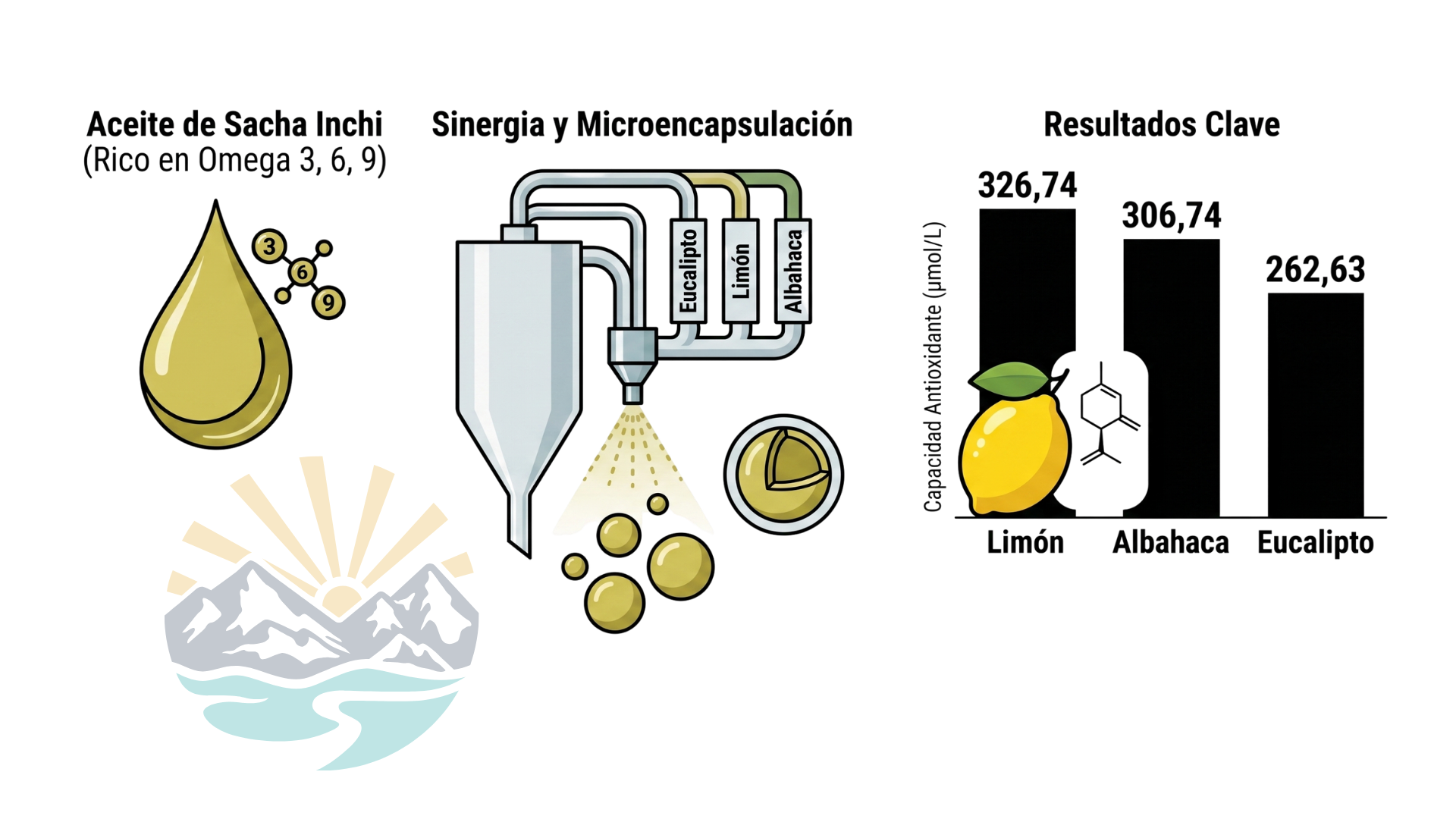
The oxidation of polyunsaturated fatty acids represents a critical limitation in the stability of vegetable oils, as their exposure to environmental conditions favors deterioration. In this context, the incorporation of natural antioxidants, such as essential oils, and the application of protective technologies, such as microencapsulation, constitute promising strategies for preserving quality and extending shelf life. The objective of this research was to microencapsulate sacha inchi oil in combination with eucalyptus, lemon, and basil essential oils using spray drying. A mixture of maltodextrin, gum arabic, and sacha inchi oil in a 1:1:1 ratio was used, incorporating essential oils at 0.5%, 0.4%, and 0.5%, respectively, with an inlet temperature of 150°C. Microcapsule formation was confirmed by FTIR-ATR spectrophotometry. Additionally, physical properties of the resulting powders were evaluated using the Carr and Hausner indices, yielding values above 38 and 1.6, indicating poor flowability and compressibility. Antioxidant capacity was determined by DPPH assay with dilutions of 1:200, 1:250, and 1:300, after dissolving 0.1 g of sample in 20, 25, and 30 mL of distilled water. Results demonstrated that the sacha inchi with lemon essential oil formulation exhibited the best antioxidant performance among all mixtures, recording a Carr index of 42.23, a Hausner index of 1.42, and an antioxidant capacity of 326.74 µmol/L Trolox equivalents. This study confirms the technical feasibility of the process for protecting Amazonian bioactive compounds and enhancing their commercialization potential.
Downloads
References
Baranauskaitė, J., Ivanauskas, L., Mastelkova, R., Kopustinskiene, D., Baranauskas, A., & Bernatoniene, J. (2017). Formulation and characterization of Turkish oregano microcapsules prepared by spray-drying technology. Pharmaceutical Development and Technology, 22(6), 792–803. https://doi.org/10.1080/10837450.2016.1189934
Benoudjit, F., Maameri, L., & Ouared, K. (2020). Evaluation of the quality and composition of lemon (Citrus limon) peel essential oil from an Algerian fruit juice industry. Algerian Journal of Environmental Science and Technology, 6(4), 1575–1581.
Bobo-García, G., Davidov-Pardo, C., Arroqui, C., Vírseda, P., Marín-Arroyo, M., & Navarro, M. (2015). Intralaboratory validation of microplate methods for total phenolic content and antioxidant activity in polyphenolic extracts. Journal of the Science of Food and Agriculture, 95(1), 204–209. https://doi.org/10.1002/jsfa.6706
Boom, E., Orozco, J., Alean, J., & Rojano, B. (2018). Evaluation of antioxidant activity of eucalyptus essential oils grown in Colombia. Información Tecnológica, 29(6), 57–66. https://doi.org/10.4067/S0718-07642018000600057
Bringas-Lantigua, M., Valdés, D., & Pino, J. (2012). Influence of spray-dryer air temperatures on encapsulated lime essential oil. International Journal of Food Science & Technology, 47(7), 1511–1517. https://doi.org/10.1111/j.1365-2621.2012.02999.x
Fanali, C. (2011). Chemical characterization of sacha inchi (Plukenetia volubilis L.) oil. Journal of Agricultural and Food Chemistry, 59(3), 13045–13048. https://doi.org/10.1021/jf203184y
Fernández, J. S., de Souza, E. L., Oliveira, J. R., Alves, A. C., Kotzebue, L. R., da Silva, D. L., & Tejo, M. (2020). Microencapsulation of sweet orange essential oil using maltodextrin and gelatin mixtures: Preparation, characterization, antimicrobial and antioxidant activities. International Journal of Biological Macromolecules, 143, 991–999. https://doi.org/10.1016/j.ijbiomac.2019.09.160
Flores, C., Pérez, J., & Minor, H. (2017). Mechanisms of lipid oxidation in food emulsions and use of plant-derived antioxidants for their control. TecnoCultura, 10(3), 17–30.
Guija-Poma, E., Inocente-Camones, M., Ponce-Pardo, J., & Zarzosa-Norabuena, E. (2015). Evaluación de la técnica 2,2-difenil-1-picrilhidrazilo (DPPH) para determinar capacidad antioxidante. Horizonte Médico, 15(1), 57–60. https://doi.org/10.24265/horizmed.2015.v15n1.08
Pastuña-Pullatasig, A., López-Hernández, O., Debut, A., Vaca, A., Rodríguez-Leyes, E., Vicente, R., González, V., & Tapia-Hernández, F. (2016). Microencapsulation of sacha inchi oil (Plukenetia volubilis L.) by spray drying. Revista Colombiana de Ciencias Químico-Farmacéuticas, 45(3), 422–437. https://doi.org/10.15446/rcciquifa.v45n3.62029
Pugliese, A., Cabassi, G., Chiavaro, E., Paciulli, M., Carini, E., & Mucchetti, G. (2017). Physical characterization of whole and skim dried milk powders. Journal of Food Science and Technology, 54(11), 3433–3442. https://doi.org/10.1007/s13197-017-2795-1
Razola, M. C., Guerra, E. J., García, B., & Verardo, V. (2021). Recent developments in extraction and encapsulation techniques of orange essential oil. Food Chemistry, 354. https://doi.org/10.1016/j.foodchem.2021.129575
Torrenegra-Alarcón, M., Granados-Conde, C., Durán-Lengua, M., León-Méndez, G., Yáñez-Rueda, X., Martínez, C., & Pájaro-Castro, N. (2016). Chemical composition and antibacterial activity of essential oils.
Yáñez, J., Porras, J., Alamilla, L., & Palacios, E. (2018). Chemical components distribution and morphology of microcapsules of paprika oleoresin by microscopy and spectroscopy. Food Hydrocolloids. https://doi.org/10.1016/j.foodhyd.2018.02.005
Downloads
Recibido
Aceptado
Published
Issue
Section
Categories
License

This work is licensed under a Creative Commons Attribution 4.0 International License.
Cualquier usuario o lector es libre de:
-
Compartir: Copiar y redistribuir el material en cualquier medio o formato.
-
Adaptar: Remezclar, transformar y construir a partir del material para cualquier propósito, incluso comercial.
Bajo la siguiente condición estricta:
-
Reconocimiento (Atribución): Se debe otorgar el crédito correspondiente de manera adecuada. Quien utilice el material debe citar a los autores originales, mencionar a Horizontes Amazónicos como el medio de publicación original, proporcionar un enlace a la licencia e indicar claramente si se ha realizado algún cambio sobre el trabajo original.