¿Chocolate o riqueza? Replicación transnacional de la correlación entre consumo de chocolate y Premios Nobel con datos actualizados (1901–2025), inclusión de América Latina y modelos de conteo con exceso de ceros
DOI:
https://doi.org/10.67321/gxffd102Palabras clave:
falacia ecológica, replicación, regresión binomial negativa inflada por ceros, Premios Nobel, América LatinaResumen
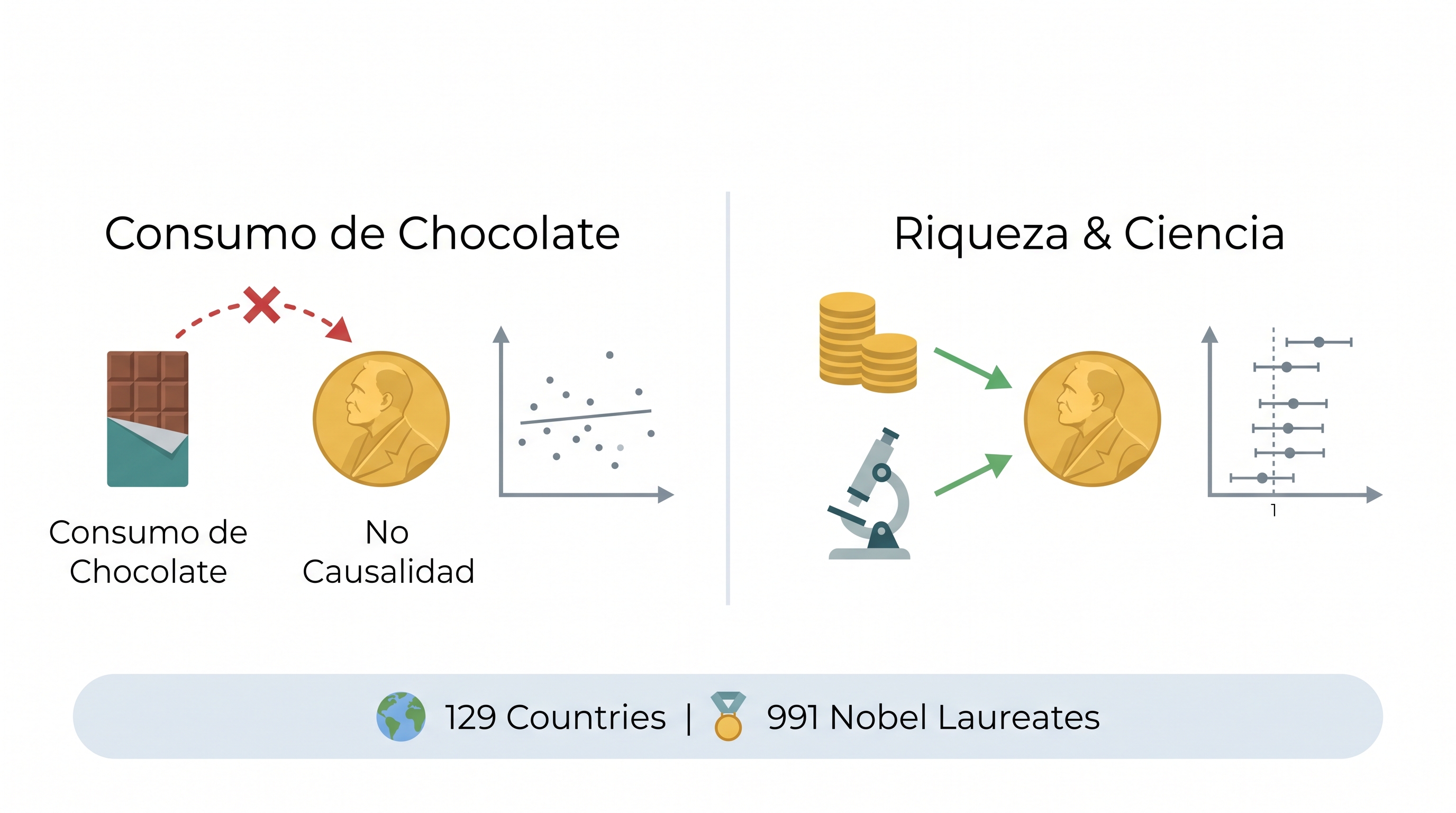
La correlación entre consumo per cápita de chocolate y laureados Nobel por 10 millones de habitantes (r = 0.791) es un ejemplo clásico de falacia ecológica, rara vez replicado con datos armonizados y modelos para conteos con exceso de ceros. Se buscó replicarla y ampliarla incorporando a América Latina y el Caribe (ALC) y controles macroeconómicos históricos. Se realizó un estudio ecológico, retrospectivo y transnacional con 129 países (19 de ALC) y 991 premios individuales (1901–2025), atribuidos por país de nacimiento y de afiliación. La exposición fue el cacao disponible para consumo (FAOSTAT); los controles, el PIB per cápita de 1960–2022, el gasto en I+D, la matrícula terciaria y las publicaciones científicas. El análisis avanzó de correlaciones simples y parciales a modelos de Poisson, binomial negativa (BN), inflados por ceros (ZIP, ZINB) y hurdle. En los 23 países originales, la correlación no se reprodujo con la medida armonizada (r = 0.19; p = 0.37). En la muestra ampliada, la correlación cruda (r = 0.37; p < 0.001) desapareció al ajustar por PIB (r parcial = 0.10; p = 0.24). En los modelos BN y ZINB ajustados, la razón de tasas de incidencia del chocolate osciló entre 1.09 y 1.15, con intervalos que incluyeron la unidad; el PIB y la I+D fueron predictores robustos. La leche, usada como control de falsificación, mostró una asociación residual mayor que la del chocolate. La riqueza y la capacidad científica, y no el chocolate, explican la distribución de los Premios Nobel
Descargas
Referencias
Apgar, J., & Tarka, S. (2019). Methylxanthine composition and consumption patterns of cocoa and chocolate products. En G. A. Spiller (Ed.), Caffeine. CRC Press. https://doi.org/10.1201/9780429126789-7
Arabpour, Z., Arabpour, Z., & Jazayeri, S. (2026). Effect of chronic dark chocolate or cocoa intake on cognitive function: A GRADE-assessed systematic review and meta-analysis of randomized controlled trials. Nutrition Reviews. https://doi.org/10.1093/nutrit/nuaf286
Baker, L. D., Manson, J. E., Rapp, S. R., Sesso, H. D., Gaussoin, S. A., Shumaker, S. A., & Espeland, M. A. (2023). Effects of cocoa extract and a multivitamin on cognitive function: A randomized clinical trial. Alzheimer's & Dementia, 19(4), 1308–1319. https://doi.org/10.1002/alz.12767
Banco Mundial. (2025). Scientific and technical journal articles (IP.JRN.ARTC.SC) [Conjunto de datos]. World Development Indicators. https://ourworldindata.org/grapher/scientific-and-technical-journal-articles
Bolt, J., & van Zanden, J. L. (2024). Maddison-style estimates of the evolution of the world economy: A new 2023 update. Journal of Economic Surveys. https://doi.org/10.1111/joes.12618
Brickman, A. M., Khan, U. A., Provenzano, F. A., Yeung, L.-K., Suzuki, W., Schroeter, H., Wall, M., Sloan, R. P., & Small, S. A. (2014). Enhancing dentate gyrus function with dietary flavanols improves cognition in older adults. Nature Neuroscience, 17(12), 1798–1803. https://doi.org/10.1038/nn.3850
Brickman, A. M., Yeung, L.-K., Alschuler, D. M., Ottaviani, J. I., Kuhnle, G. G. C., Sloan, R. P., Luttmann-Gibson, H., Copeland, T., Schroeter, H., Sesso, H. D., Manson, J. E., Wall, M., & Small, S. A. (2023). Dietary flavanols restore hippocampal-dependent memory in older adults with lower diet quality and lower habitual flavanol consumption. Proceedings of the National Academy of Sciences, 120(23), e2216932120. https://doi.org/10.1073/pnas.2216932120
Cameron, A. C., & Trivedi, P. K. (2013). Regression analysis of count data (2.ª ed.). Cambridge University Press. https://doi.org/10.1017/CBO9781139013567
Cheng, N., Bell, L., Lamport, D. J., & Williams, C. M. (2022). Dietary flavonoids and human cognition: A meta-analysis. Molecular Nutrition & Food Research, 66, e2100976. https://doi.org/10.1002/mnfr.202100976
Cortés, J. D., & Andrade, D. A. (2022). The Colombian scientific elite—Science mapping and a comparison with Nobel Prize laureates using a composite citation indicator. PLoS ONE, 17(6), e0269116. https://doi.org/10.1371/journal.pone.0269116
Del Prete, M., & Samoggia, A. (2020). Chocolate consumption and purchasing behaviour review: Research issues and insights for future research. Sustainability, 12(14), 5586. https://doi.org/10.3390/su12145586
Desideri, G., Kwik-Uribe, C., Grassi, D., Necozione, S., Ghiadoni, L., Mastroiacovo, D., Raffaele, A., Ferri, L., Bocale, R., Lechiara, M. C., Marini, C., & Ferri, C. (2012). Benefits in cognitive function, blood pressure, and insulin resistance through cocoa flavanol consumption in elderly subjects with mild cognitive impairment: The Cocoa, Cognition, and Aging (CoCoA) Study. Hypertension, 60(3), 794–801. https://doi.org/10.1161/HYPERTENSIONAHA.112.193060
Doi, H., Heeren, A., & Maurage, P. (2014). Scientific activity is a better predictor of Nobel award chances than dietary habits and economic factors. PLoS ONE, 9(3), e92612. https://doi.org/10.1371/journal.pone.0092612
Dunstan, F. (2013). Nobel prizes, chocolate and milk: The statistical view. Practical Neurology, 13(3), 206–207. https://doi.org/10.1136/practneurol-2013-000588
FAO. (2025). FAOSTAT: Food balances (2010–) [Conjunto de datos]. Organización de las Naciones Unidas para la Alimentación y la Agricultura. https://www.fao.org/faostat/en/#data/FBS
Heckman, J. J. (1979). Sample selection bias as a specification error. Econometrica, 47(1), 153–161. https://doi.org/10.2307/1912352
Heinze, T., & Fuchs, J. E. (2022). National and organizational patterns of Nobel laureate careers in physiology/medicine, physics, and chemistry. Scientometrics, 127, 7273–7288. https://doi.org/10.1007/s11192-021-04250-0
Heinze, T., von der Heyden, M., & Pithan, D. (2020). Institutional environments and breakthroughs in science. Comparison of France, Germany, the United Kingdom, and the United States. PLoS ONE, 15(9), e0239805. https://doi.org/10.1371/journal.pone.0239805
Lambert, D. (1992). Zero-inflated Poisson regression, with an application to defects in manufacturing. Technometrics, 34(1), 1–14. https://doi.org/10.2307/1269547
Li, J. (2013). Economy and Nobel prizes: Cause behind chocolate and milk? Practical Neurology, 14(1), e1. https://doi.org/10.1136/practneurol-2013-000545
Li, Q.-F. (2025). Assessing and adjusting for bias in ecological analysis using multiple sample datasets. BMC Medical Research Methodology, 25. https://doi.org/10.1186/s12874-025-02552-y
Linthwaite, S., & Fuller, G. N. (2013). Milk, chocolate and Nobel prizes. Practical Neurology, 13(1), 63. https://doi.org/10.1136/practneurol-2012-000471
Loney, T., & Nagelkerke, N. J. (2014). The individualistic fallacy, ecological studies and instrumental variables: A causal interpretation. Emerging Themes in Epidemiology, 11, 18. https://doi.org/10.1186/1742-7622-11-18
Mastroiacovo, D., Kwik-Uribe, C., Grassi, D., Necozione, S., Raffaele, A., Pistacchio, L., Righetti, R., Bocale, R., Lechiara, M. C., Marini, C., Ferri, C., & Desideri, G. (2015). Cocoa flavanol consumption improves cognitive function, blood pressure control, and metabolic profile in elderly subjects: The Cocoa, Cognition, and Aging (CoCoA) Study—A randomized controlled trial. The American Journal of Clinical Nutrition, 101(3), 538–548. https://doi.org/10.3945/ajcn.114.092189
Maurage, P., Heeren, A., & Pesenti, M. (2013). Does chocolate consumption really boost Nobel award chances? The peril of over-interpreting correlations in health studies. The Journal of Nutrition, 143(6), 931–933. https://doi.org/10.3945/jn.113.174813
McClintock, S., Stangl, D., & Çetinkaya-Rundel, M. (2014). Taking a chance in the classroom: The real secret to genius? Reading between the lines. CHANCE, 27(1), 41–44. https://doi.org/10.1080/09332480.2014.890869
Messerli, F. H. (2012). Chocolate consumption, cognitive function, and Nobel laureates. The New England Journal of Medicine, 367(16), 1562–1564. https://doi.org/10.1056/NEJMon1211064
Mullahy, J. (1986). Specification and testing of some modified count data models. Journal of Econometrics, 33(3), 341–365. https://doi.org/10.1016/0304-4076(86)90002-3
Nobel Prize Outreach. (2025). All Nobel Prizes [Base de datos]. NobelPrize.org. https://www.nobelprize.org/prizes/lists/all-nobel-prizes/
Our World in Data. (2025a). Cocoa bean consumption per person [Conjunto de datos, a partir de FAOSTAT]. https://ourworldindata.org/grapher/chocolate-consumption-per-person
Our World in Data. (2025b). Research & development spending as a share of GDP [Conjunto de datos, a partir de UNESCO-UIS y Banco Mundial]. https://ourworldindata.org/grapher/research-spending-gdp
Our World in Data. (2025c). Gross enrollment ratio in tertiary education [Conjunto de datos, a partir de UNESCO-UIS]. https://ourworldindata.org/grapher/gross-enrollment-ratio-in-tertiary-education
Pietrucha, J. (2018). Country-specific determinants of world university rankings. Scientometrics, 114, 1129–1139. https://doi.org/10.1007/s11192-017-2634-1
Pollet, T. V., Tybur, J. M., Frankenhuis, W. E., & Rickard, I. J. (2014). What can cross-cultural correlations teach us about human nature? Human Nature, 25(3), 410–429. https://doi.org/10.1007/s12110-014-9206-3
Prinz, A. (2020). Chocolate consumption and Noble laureates [Documento de trabajo]. SSRN. https://doi.org/10.2139/ssrn.3562373
rfordatascience. (2019). Nobel Prize winners [Conjunto de datos, TidyTuesday 2019-05-14]. GitHub. https://github.com/rfordatascience/tidytuesday/tree/master/data/2019/2019-05-14
Rizzuto, L., Anido, J. D., & Azuaje, R. (2017). El consumo de cacao en Venezuela y en el mundo desde una perspectiva sostenible (1960–2014) (pp. 23–49).
Robinson, W. S. (1950). Ecological correlations and the behavior of individuals. American Sociological Review, 15(3), 351–357. https://doi.org/10.2307/2087176
Rodríguez-Navarro, A., & Brito, R. (2022). The link between countries' economic and scientific wealth has a complex dependence on technological activity and research policy. Scientometrics, 127, 2871–2896. https://doi.org/10.1007/s11192-022-04313-w
Schlagberger, E. M., Bornmann, L., & Bauer, J. (2016). At what institutions did Nobel laureates do their prize-winning work? An analysis of biographical information on Nobel laureates from 1994 to 2014. Scientometrics, 109, 723–767. https://doi.org/10.1007/s11192-016-2059-2
Seabold, S., & Perktold, J. (2010). Statsmodels: Econometric and statistical modeling with Python. En Proceedings of the 9th Python in Science Conference (pp. 92–96). https://doi.org/10.25080/Majora-92bf1922-011
Szromek, A. (2026). Cross-level inference errors in scientific interpretation—From ecological correlation to the control of inference and communication levels. Publications, 14, 41. https://doi.org/10.3390/publications14030041
Vuong, Q. H. (1989). Likelihood ratio tests for model selection and non-nested hypotheses. Econometrica, 57(2), 307–333. https://doi.org/10.2307/1912557
Vyas, C. M., Manson, J. E., Sesso, H. D., Rist, P. M., Weinberg, A., Kim, E., Moorthy, M. V., Cook, N. R., & Okereke, O. I. (2024). Effect of cocoa extract supplementation on cognitive function: Results from the clinic subcohort of the COSMOS trial. The American Journal of Clinical Nutrition, 119(1), 39–48. https://doi.org/10.1016/j.ajcnut.2023.10.031
Recibido
Aceptado
Publicado
Número
Sección
Categorías
Licencia
Derechos de autor 2026 Samantha Lisseth Romero Ruiz

Esta obra está bajo una licencia internacional Creative Commons Atribución 4.0.
Cualquier usuario o lector es libre de:
-
Compartir: Copiar y redistribuir el material en cualquier medio o formato.
-
Adaptar: Remezclar, transformar y construir a partir del material para cualquier propósito, incluso comercial.
Bajo la siguiente condición estricta:
-
Reconocimiento (Atribución): Se debe otorgar el crédito correspondiente de manera adecuada. Quien utilice el material debe citar a los autores originales, mencionar a Horizontes Amazónicos como el medio de publicación original, proporcionar un enlace a la licencia e indicar claramente si se ha realizado algún cambio sobre el trabajo original.