Chocolate or wealth? A cross-national replication of the chocolate consumption–Nobel Prize correlation with updated data (1901–2025), inclusion of Latin America and zero-inflated count models
DOI:
https://doi.org/10.67321/gxffd102Keywords:
ecological fallacy, replication, zero-inflated negative binomial regression, Nobel Prize, Latin AmericaAbstract
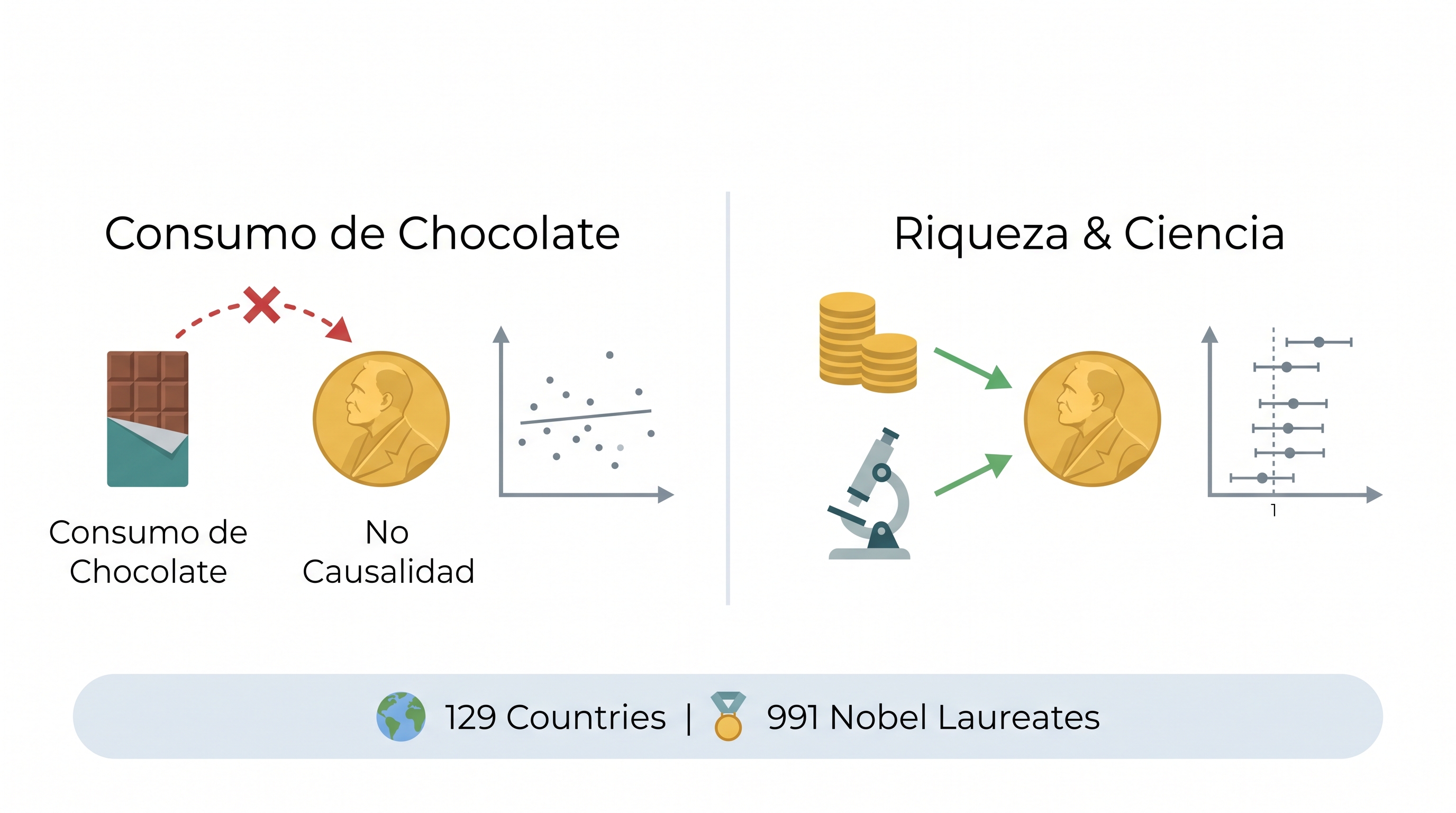
The correlation between per capita chocolate consumption and Nobel laureates per 10 million inhabitants (r = 0.791) became a textbook example of the ecological fallacy, yet it has rarely been replicated with harmonized data, unselected samples and models suited to zero-heavy counts. We aimed to replicate and extend that finding by including Latin America and the Caribbean (LAC) and historically lagged macroeconomic controls. We conducted an ecological, retrospective, cross-national study of 129 countries (19 in LAC) and 991 individual prizes awarded between 1901 and 2025, attributed by country of birth and of affiliation. Exposure was cocoa available for consumption (FAOSTAT); controls were mean GDP per capita for 1960–2022, R&D expenditure, tertiary enrollment and scientific output. The analysis moved from simple and partial correlations to Poisson, negative binomial (NB), zero-inflated Poisson and NB (ZIP, ZINB) and hurdle models. In Messerli's 23 countries the correlation was not reproduced with the harmonized measure (r = 0.19; p = 0.37). In the extended sample, the crude correlation (r = 0.37; p < 0.001) vanished after adjustment for GDP (partial r = 0.10; p = 0.24). In adjusted NB and ZINB models, the incidence rate ratio for chocolate ranged from 1.09 to 1.15 with intervals including one, whereas GDP and R&D were robust predictors. Milk consumption, used as a falsification control, showed a stronger residual association than chocolate. Wealth and scientific capacity, not chocolate, explain the distribution of Nobel Prizes.
Downloads
References
Apgar, J., & Tarka, S. (2019). Methylxanthine composition and consumption patterns of cocoa and chocolate products. En G. A. Spiller (Ed.), Caffeine. CRC Press. https://doi.org/10.1201/9780429126789-7
Arabpour, Z., Arabpour, Z., & Jazayeri, S. (2026). Effect of chronic dark chocolate or cocoa intake on cognitive function: A GRADE-assessed systematic review and meta-analysis of randomized controlled trials. Nutrition Reviews. https://doi.org/10.1093/nutrit/nuaf286
Baker, L. D., Manson, J. E., Rapp, S. R., Sesso, H. D., Gaussoin, S. A., Shumaker, S. A., & Espeland, M. A. (2023). Effects of cocoa extract and a multivitamin on cognitive function: A randomized clinical trial. Alzheimer's & Dementia, 19(4), 1308–1319. https://doi.org/10.1002/alz.12767
Banco Mundial. (2025). Scientific and technical journal articles (IP.JRN.ARTC.SC) [Conjunto de datos]. World Development Indicators. https://ourworldindata.org/grapher/scientific-and-technical-journal-articles
Bolt, J., & van Zanden, J. L. (2024). Maddison-style estimates of the evolution of the world economy: A new 2023 update. Journal of Economic Surveys. https://doi.org/10.1111/joes.12618
Brickman, A. M., Khan, U. A., Provenzano, F. A., Yeung, L.-K., Suzuki, W., Schroeter, H., Wall, M., Sloan, R. P., & Small, S. A. (2014). Enhancing dentate gyrus function with dietary flavanols improves cognition in older adults. Nature Neuroscience, 17(12), 1798–1803. https://doi.org/10.1038/nn.3850
Brickman, A. M., Yeung, L.-K., Alschuler, D. M., Ottaviani, J. I., Kuhnle, G. G. C., Sloan, R. P., Luttmann-Gibson, H., Copeland, T., Schroeter, H., Sesso, H. D., Manson, J. E., Wall, M., & Small, S. A. (2023). Dietary flavanols restore hippocampal-dependent memory in older adults with lower diet quality and lower habitual flavanol consumption. Proceedings of the National Academy of Sciences, 120(23), e2216932120. https://doi.org/10.1073/pnas.2216932120
Cameron, A. C., & Trivedi, P. K. (2013). Regression analysis of count data (2.ª ed.). Cambridge University Press. https://doi.org/10.1017/CBO9781139013567
Cheng, N., Bell, L., Lamport, D. J., & Williams, C. M. (2022). Dietary flavonoids and human cognition: A meta-analysis. Molecular Nutrition & Food Research, 66, e2100976. https://doi.org/10.1002/mnfr.202100976
Cortés, J. D., & Andrade, D. A. (2022). The Colombian scientific elite—Science mapping and a comparison with Nobel Prize laureates using a composite citation indicator. PLoS ONE, 17(6), e0269116. https://doi.org/10.1371/journal.pone.0269116
Del Prete, M., & Samoggia, A. (2020). Chocolate consumption and purchasing behaviour review: Research issues and insights for future research. Sustainability, 12(14), 5586. https://doi.org/10.3390/su12145586
Desideri, G., Kwik-Uribe, C., Grassi, D., Necozione, S., Ghiadoni, L., Mastroiacovo, D., Raffaele, A., Ferri, L., Bocale, R., Lechiara, M. C., Marini, C., & Ferri, C. (2012). Benefits in cognitive function, blood pressure, and insulin resistance through cocoa flavanol consumption in elderly subjects with mild cognitive impairment: The Cocoa, Cognition, and Aging (CoCoA) Study. Hypertension, 60(3), 794–801. https://doi.org/10.1161/HYPERTENSIONAHA.112.193060
Doi, H., Heeren, A., & Maurage, P. (2014). Scientific activity is a better predictor of Nobel award chances than dietary habits and economic factors. PLoS ONE, 9(3), e92612. https://doi.org/10.1371/journal.pone.0092612
Dunstan, F. (2013). Nobel prizes, chocolate and milk: The statistical view. Practical Neurology, 13(3), 206–207. https://doi.org/10.1136/practneurol-2013-000588
FAO. (2025). FAOSTAT: Food balances (2010–) [Conjunto de datos]. Organización de las Naciones Unidas para la Alimentación y la Agricultura. https://www.fao.org/faostat/en/#data/FBS
Heckman, J. J. (1979). Sample selection bias as a specification error. Econometrica, 47(1), 153–161. https://doi.org/10.2307/1912352
Heinze, T., & Fuchs, J. E. (2022). National and organizational patterns of Nobel laureate careers in physiology/medicine, physics, and chemistry. Scientometrics, 127, 7273–7288. https://doi.org/10.1007/s11192-021-04250-0
Heinze, T., von der Heyden, M., & Pithan, D. (2020). Institutional environments and breakthroughs in science. Comparison of France, Germany, the United Kingdom, and the United States. PLoS ONE, 15(9), e0239805. https://doi.org/10.1371/journal.pone.0239805
Lambert, D. (1992). Zero-inflated Poisson regression, with an application to defects in manufacturing. Technometrics, 34(1), 1–14. https://doi.org/10.2307/1269547
Li, J. (2013). Economy and Nobel prizes: Cause behind chocolate and milk? Practical Neurology, 14(1), e1. https://doi.org/10.1136/practneurol-2013-000545
Li, Q.-F. (2025). Assessing and adjusting for bias in ecological analysis using multiple sample datasets. BMC Medical Research Methodology, 25. https://doi.org/10.1186/s12874-025-02552-y
Linthwaite, S., & Fuller, G. N. (2013). Milk, chocolate and Nobel prizes. Practical Neurology, 13(1), 63. https://doi.org/10.1136/practneurol-2012-000471
Loney, T., & Nagelkerke, N. J. (2014). The individualistic fallacy, ecological studies and instrumental variables: A causal interpretation. Emerging Themes in Epidemiology, 11, 18. https://doi.org/10.1186/1742-7622-11-18
Mastroiacovo, D., Kwik-Uribe, C., Grassi, D., Necozione, S., Raffaele, A., Pistacchio, L., Righetti, R., Bocale, R., Lechiara, M. C., Marini, C., Ferri, C., & Desideri, G. (2015). Cocoa flavanol consumption improves cognitive function, blood pressure control, and metabolic profile in elderly subjects: The Cocoa, Cognition, and Aging (CoCoA) Study—A randomized controlled trial. The American Journal of Clinical Nutrition, 101(3), 538–548. https://doi.org/10.3945/ajcn.114.092189
Maurage, P., Heeren, A., & Pesenti, M. (2013). Does chocolate consumption really boost Nobel award chances? The peril of over-interpreting correlations in health studies. The Journal of Nutrition, 143(6), 931–933. https://doi.org/10.3945/jn.113.174813
McClintock, S., Stangl, D., & Çetinkaya-Rundel, M. (2014). Taking a chance in the classroom: The real secret to genius? Reading between the lines. CHANCE, 27(1), 41–44. https://doi.org/10.1080/09332480.2014.890869
Messerli, F. H. (2012). Chocolate consumption, cognitive function, and Nobel laureates. The New England Journal of Medicine, 367(16), 1562–1564. https://doi.org/10.1056/NEJMon1211064
Mullahy, J. (1986). Specification and testing of some modified count data models. Journal of Econometrics, 33(3), 341–365. https://doi.org/10.1016/0304-4076(86)90002-3
Nobel Prize Outreach. (2025). All Nobel Prizes [Base de datos]. NobelPrize.org. https://www.nobelprize.org/prizes/lists/all-nobel-prizes/
Our World in Data. (2025a). Cocoa bean consumption per person [Conjunto de datos, a partir de FAOSTAT]. https://ourworldindata.org/grapher/chocolate-consumption-per-person
Our World in Data. (2025b). Research & development spending as a share of GDP [Conjunto de datos, a partir de UNESCO-UIS y Banco Mundial]. https://ourworldindata.org/grapher/research-spending-gdp
Our World in Data. (2025c). Gross enrollment ratio in tertiary education [Conjunto de datos, a partir de UNESCO-UIS]. https://ourworldindata.org/grapher/gross-enrollment-ratio-in-tertiary-education
Pietrucha, J. (2018). Country-specific determinants of world university rankings. Scientometrics, 114, 1129–1139. https://doi.org/10.1007/s11192-017-2634-1
Pollet, T. V., Tybur, J. M., Frankenhuis, W. E., & Rickard, I. J. (2014). What can cross-cultural correlations teach us about human nature? Human Nature, 25(3), 410–429. https://doi.org/10.1007/s12110-014-9206-3
Prinz, A. (2020). Chocolate consumption and Noble laureates [Documento de trabajo]. SSRN. https://doi.org/10.2139/ssrn.3562373
rfordatascience. (2019). Nobel Prize winners [Conjunto de datos, TidyTuesday 2019-05-14]. GitHub. https://github.com/rfordatascience/tidytuesday/tree/master/data/2019/2019-05-14
Rizzuto, L., Anido, J. D., & Azuaje, R. (2017). El consumo de cacao en Venezuela y en el mundo desde una perspectiva sostenible (1960–2014) (pp. 23–49).
Robinson, W. S. (1950). Ecological correlations and the behavior of individuals. American Sociological Review, 15(3), 351–357. https://doi.org/10.2307/2087176
Rodríguez-Navarro, A., & Brito, R. (2022). The link between countries' economic and scientific wealth has a complex dependence on technological activity and research policy. Scientometrics, 127, 2871–2896. https://doi.org/10.1007/s11192-022-04313-w
Schlagberger, E. M., Bornmann, L., & Bauer, J. (2016). At what institutions did Nobel laureates do their prize-winning work? An analysis of biographical information on Nobel laureates from 1994 to 2014. Scientometrics, 109, 723–767. https://doi.org/10.1007/s11192-016-2059-2
Seabold, S., & Perktold, J. (2010). Statsmodels: Econometric and statistical modeling with Python. En Proceedings of the 9th Python in Science Conference (pp. 92–96). https://doi.org/10.25080/Majora-92bf1922-011
Szromek, A. (2026). Cross-level inference errors in scientific interpretation—From ecological correlation to the control of inference and communication levels. Publications, 14, 41. https://doi.org/10.3390/publications14030041
Vuong, Q. H. (1989). Likelihood ratio tests for model selection and non-nested hypotheses. Econometrica, 57(2), 307–333. https://doi.org/10.2307/1912557
Vyas, C. M., Manson, J. E., Sesso, H. D., Rist, P. M., Weinberg, A., Kim, E., Moorthy, M. V., Cook, N. R., & Okereke, O. I. (2024). Effect of cocoa extract supplementation on cognitive function: Results from the clinic subcohort of the COSMOS trial. The American Journal of Clinical Nutrition, 119(1), 39–48. https://doi.org/10.1016/j.ajcnut.2023.10.031
Downloads
Recibido
Aceptado
Published
Issue
Section
Categories
License
Copyright (c) 2026 Samantha Lisseth Romero Ruiz

This work is licensed under a Creative Commons Attribution 4.0 International License.
Cualquier usuario o lector es libre de:
-
Compartir: Copiar y redistribuir el material en cualquier medio o formato.
-
Adaptar: Remezclar, transformar y construir a partir del material para cualquier propósito, incluso comercial.
Bajo la siguiente condición estricta:
-
Reconocimiento (Atribución): Se debe otorgar el crédito correspondiente de manera adecuada. Quien utilice el material debe citar a los autores originales, mencionar a Horizontes Amazónicos como el medio de publicación original, proporcionar un enlace a la licencia e indicar claramente si se ha realizado algún cambio sobre el trabajo original.