
¿Puede la inteligencia artificial sustituir profesiones? Revisión sistemática cuantitativa de la evidencia sobre exposición, desplazamiento y aumento laboral (2016–2026)
DOI:
https://doi.org/10.67321/7d3ygr02Palabras clave:
inteligencia artificial generativa, automatización, exposición ocupacional, mercado laboral, sustitución del empleo, revisión sistemáticaResumen
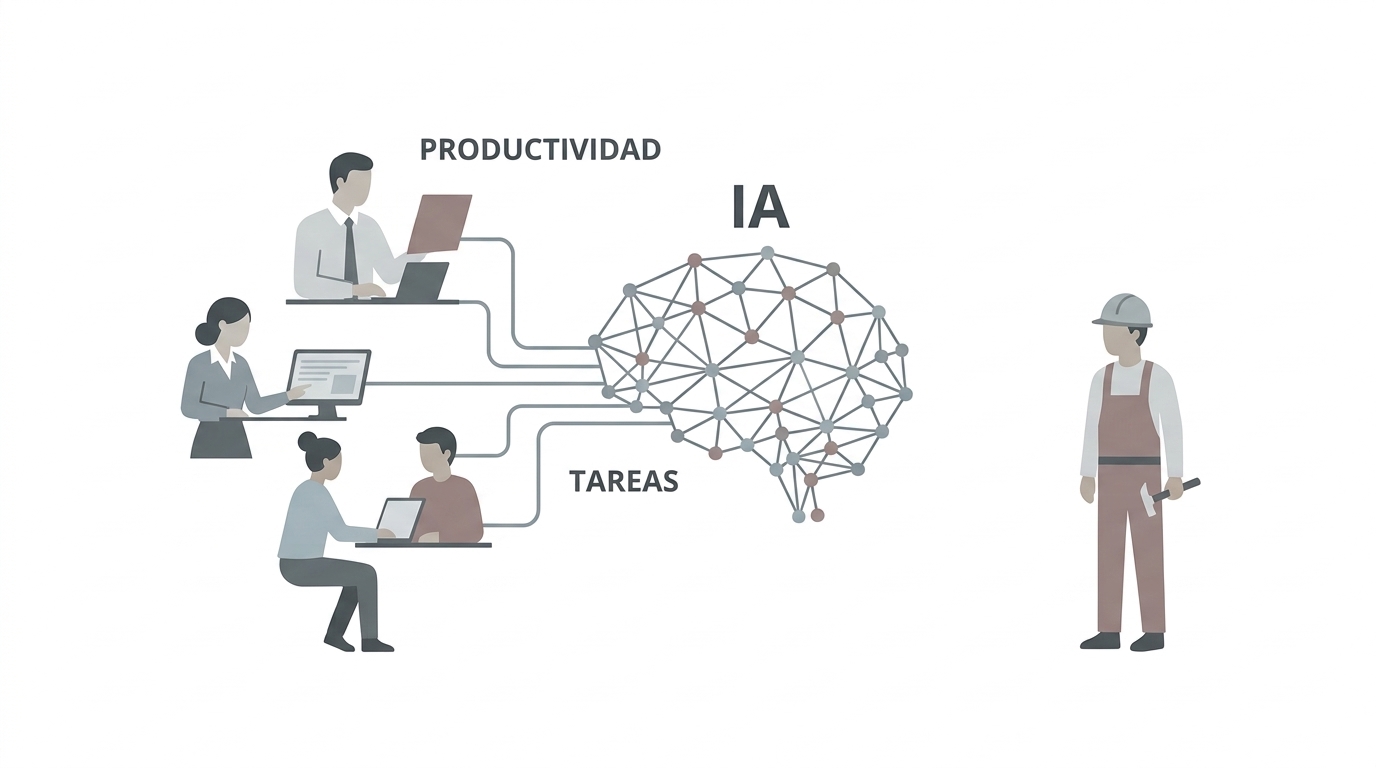
Introducción: la irrupción de la inteligencia artificial (IA) generativa ha reactivado el debate sobre la sustitución de profesiones completas por sistemas algorítmicos. Objetivo: cuantificar, a partir de la evidencia publicada entre 2016 y 2026, la magnitud esperada y observada de la sustitución laboral por IA e identificar las profesiones con mayor y menor probabilidad de ser sustituidas. Metodología: revisión sistemática conforme a PRISMA 2020. Se ejecutaron 20 consultas en un motor académico y repositorios institucionales (OIT, FMI, OCDE, Banco Mundial, NBER, SSRN, arXiv), complementadas con búsqueda de citas. De 211 registros, se incluyeron 34 estudios cuantitativos (exposición ocupacional, uso observado, efectos causales, experimentos y proyecciones), cuya calidad se valoró con cinco criterios. Resultados: el 79,4 % de los estudios se publicó después del lanzamiento de ChatGPT. Las estimaciones de empleo en alto riesgo de sustitución total descendieron desde una mediana de 14 % (intervalo 9–47 %) en los modelos por ocupación previos a la IA generativa hasta 4,5 % (0,4–8 %) en los modelos por tareas de 2023–2025; en cambio, la exposición parcial alcanza al 25 % del empleo mundial (OIT) o al 40 % (FMI), con 26–27 % en Ecuador. Los efectos observados son negativos y focalizados (mediana −14 %): avisos freelance de escritura y programación (−21 %) y empleo de trabajadores de 22–25 años en ocupaciones expuestas (−13 % a −19 %), sin efectos agregados sobre ingresos u horas. Los experimentos muestran ganancias de productividad (mediana +25,1 %). Las profesiones más señaladas fueron programadores, oficinistas, teleoperadores, redactores y contables; las menos expuestas, los oficios manuales y el cuidado directo. Conclusiones: la IA sustituye tareas antes que profesiones; la sustitución total es improbable a mediano plazo para la mayoría de ocupaciones, pero el desplazamiento ya es medible en puestos de entrada y trabajo cognitivo estandarizado.
Descargas
Referencias
Acemoglu, D. (2025). The simple macroeconomics of AI. Economic Policy, 40(121), 13–58. https://doi.org/10.1093/epolic/eiae042
Acemoglu, D., Autor, D., Hazell, J., y Restrepo, P. (2022). Artificial intelligence and jobs: Evidence from online vacancies. Journal of Labor Economics, 40(S1), S293–S340. https://doi.org/10.1086/718327
Acemoglu, D., y Restrepo, P. (2019). Automation and new tasks: How technology displaces and reinstates labor. Journal of Economic Perspectives, 33(2), 3–30. https://doi.org/10.1257/jep.33.2.3
Albanesi, S., Dias da Silva, A., Jimeno, J. F., Lamo, A., y Wabitsch, A. (2023). New technologies and jobs in Europe (NBER Working Paper No. 31357). National Bureau of Economic Research. https://doi.org/10.3386/w31357
Arntz, M., Gregory, T., y Zierahn, U. (2016). The risk of automation for jobs in OECD countries: A comparative analysis (OECD Social, Employment and Migration Working Papers No. 189). OECD Publishing. https://doi.org/10.1787/5jlz9h56dvq7-en
Autor, D., Chin, C., Salomons, A., y Seegmiller, B. (2024). New frontiers: The origins and content of new work, 1940–2018. The Quarterly Journal of Economics, 139(3), 1399–1465. https://doi.org/10.1093/qje/qjae008
Briggs, J., y Kodnani, D. (2023). The potentially large effects of artificial intelligence on economic growth. Goldman Sachs Global Economics Analyst.
Brynjolfsson, E., Li, D., y Raymond, L. (2025a). Generative AI at work. The Quarterly Journal of Economics, 140(2), 889–942. https://doi.org/10.1093/qje/qjae044
Brynjolfsson, E., Chandar, B., y Chen, R. (2025b). Canaries in the coal mine? Six facts about the recent employment effects of artificial intelligence [Documento de trabajo; actualización de agosto de 2026]. Stanford Digital Economy Lab. https://digitaleconomy.stanford.edu/publication/canaries-in-the-coal-mine-six-facts-about-the-recent-employment-effects-of-artificial-intelligence/
Cazzaniga, M., Jaumotte, F., Li, L., Melina, G., Panton, A. J., Pizzinelli, C., Rockall, E., y Tavares, M. M. (2024). Gen-AI: Artificial intelligence and the future of work (IMF Staff Discussion Note SDN/2024/001). International Monetary Fund. https://www.imf.org/-/media/files/publications/sdn/2024/english/sdnea2024001.pdf
Choi, J. H., Monahan, A., y Schwarcz, D. (2024). Lawyering in the age of artificial intelligence. Minnesota Law Review. https://papers.ssrn.com/sol3/papers.cfm?abstract_id=4626276
Chui, M., Hazan, E., Roberts, R., Singla, A., Smaje, K., Sukharevsky, A., Yee, L., y Zemmel, R. (2023). The economic potential of generative AI: The next productivity frontier. McKinsey Global Institute.
Dehouche, N. (2026). Creation, validation, obsolescence: Observed evidence of AI-driven labor market displacement, 2020–2025. Frontiers in Human Dynamics. https://doi.org/10.3389/fhumd.2026.1815037
Dell'Acqua, F., McFowland, E., Mollick, E. R., Lifshitz-Assaf, H., Kellogg, K., Rajendran, S., Krayer, L., Candelon, F., y Lakhani, K. R. (2023). Navigating the jagged technological frontier: Field experimental evidence of the effects of AI on knowledge worker productivity and quality (Harvard Business School Working Paper No. 24-013). https://doi.org/10.2139/ssrn.4573321
Demirci, O., Hannane, J., y Zhu, X. (2025). Who is AI replacing? The impact of generative AI on online freelancing platforms. Management Science. https://doi.org/10.1287/mnsc.2024.05420
Eloundou, T., Manning, S., Mishkin, P., y Rock, D. (2024). GPTs are GPTs: Labor market impact potential of LLMs. Science, 384(6702), 1306–1308. https://doi.org/10.1126/science.adj0998
Felten, E., Raj, M., y Seamans, R. (2021). Occupational, industry, and geographic exposure to artificial intelligence: A novel dataset and its potential uses. Strategic Management Journal, 42(12), 2195–2217. https://doi.org/10.1002/smj.3286
Felten, E., Raj, M., y Seamans, R. (2023). How will language modelers like ChatGPT affect occupations and industries? (arXiv:2303.01157). https://arxiv.org/abs/2303.01157
Foro Económico Mundial. (2025). The future of jobs report 2025. World Economic Forum. https://reports.weforum.org/docs/WEF_Future_of_Jobs_Report_2025.pdf
Frey, C. B., y Llanos-Paredes, P. (2025). Lost in translation: Artificial intelligence and the demand for foreign language skills [Documento de trabajo]. Oxford Martin School, University of Oxford. https://www.oxfordmartin.ox.ac.uk/publications/lost-in-translation-artificial-intelligence-and-the-demand-for-foreign-language-skills
Frey, C. B., y Osborne, M. A. (2017). The future of employment: How susceptible are jobs to computerisation? Technological Forecasting and Social Change, 114, 254–280. https://doi.org/10.1016/j.techfore.2016.08.019
Georgieff, A., y Hyee, R. (2022). Artificial intelligence and employment: New cross-country evidence. Frontiers in Artificial Intelligence, 5, 832736. https://doi.org/10.3389/frai.2022.832736
Gmyrek, P., Berg, J., y Bescond, D. (2023). Generative AI and jobs: A global analysis of potential effects on job quantity and quality (ILO Working Paper No. 96). Organización Internacional del Trabajo. https://doi.org/10.54394/FHEM8239
Gmyrek, P., Berg, J., Kamiński, K., Konopczyński, F., Ładna, A., Nafradi, B., Rosłaniec, K., y Troszyński, M. (2025). Generative AI and jobs: A refined global index of occupational exposure (ILO Working Paper No. 140). Organización Internacional del Trabajo. https://www.ilo.org/publications/generative-ai-and-jobs-refined-global-index-occupational-exposure
Gmyrek, P., Winkler, H., y Garganta, S. (2024). Buffer or bottleneck? Employment exposure to generative AI and the digital divide in Latin America (ILO Working Paper No. 121; World Bank Policy Research Working Paper No. 10863). OIT y Banco Mundial. https://www.ilo.org/sites/default/files/2024-07/WP121_web.pdf
Handa, K., Tamkin, A., McCain, M., Huang, S., Durmus, E., Heck, S., Mueller, J., Hong, J., Ritchie, S., Belonax, T., Troy, K. K., Amodei, D., Kaplan, J., Clark, J., y Ganguli, D. (2025). Which economic tasks are performed with AI? Evidence from millions of Claude conversations (arXiv:2503.04761). https://arxiv.org/abs/2503.04761
Hui, X., Reshef, O., y Zhou, L. (2024). The short-term effects of generative artificial intelligence on employment: Evidence from an online labor market. Organization Science, 35(6), 1977–1989. https://doi.org/10.1287/orsc.2023.18441
Humlum, A., y Vestergaard, E. (2025). Large language models, small labor market effects (NBER Working Paper No. 33777). National Bureau of Economic Research. https://www.nber.org/papers/w33777
Kochhar, R. (2023). Which U.S. workers are more exposed to AI on their jobs? Pew Research Center. https://www.pewresearch.org/social-trends/2023/07/26/which-u-s-workers-are-more-exposed-to-ai-on-their-jobs/
Lane, M., y Saint-Martin, A. (2021). The impact of artificial intelligence on the labour market: What do we know so far? (OECD Social, Employment and Migration Working Papers No. 256). OECD Publishing. https://doi.org/10.1787/7c895724-en
Massenkoff, M., y McCrory, P. (2026). Labor market impacts of AI: A new measure and early evidence. Anthropic. https://www.anthropic.com/research/labor-market-impacts
Nedelkoska, L., y Quintini, G. (2018). Automation, skills use and training (OECD Social, Employment and Migration Working Papers No. 202). OECD Publishing. https://doi.org/10.1787/2e2f4eea-en
Noy, S., y Zhang, W. (2023). Experimental evidence on the productivity effects of generative artificial intelligence. Science, 381(6654), 187–192. https://doi.org/10.1126/science.adh2586
Page, M. J., McKenzie, J. E., Bossuyt, P. M., Boutron, I., Hoffmann, T. C., Mulrow, C. D., Shamseer, L., Tetzlaff, J. M., Akl, E. A., Brennan, S. E., Chou, R., Glanville, J., Grimshaw, J. M., Hróbjartsson, A., Lalu, M. M., Li, T., Loder, E. W., Mayo-Wilson, E., McDonald, S., … Moher, D. (2021). The PRISMA 2020 statement: An updated guideline for reporting systematic reviews. BMJ, 372, n71. https://doi.org/10.1136/bmj.n71
Peng, S., Kalliamvakou, E., Cihon, P., y Demirer, M. (2023). The impact of AI on developer productivity: Evidence from GitHub Copilot (arXiv:2302.06590). https://arxiv.org/abs/2302.06590
PwC. (2026). Two futures for jobs in an AI era: 2026 Global AI Jobs Barometer. PricewaterhouseCoopers. https://www.pwc.com/gx/en/issues/artificial-intelligence/job-barometer/2026/2026-global-ai-jobs-barometer-global-findings.pdf
Tomlinson, K., Jaffe, S., Wang, W., Counts, S., y Suri, S. (2025). Working with AI: Measuring the occupational implications of generative AI (arXiv:2507.07935). https://arxiv.org/abs/2507.07935
Webb, M. (2020). The impact of artificial intelligence on the labor market [Documento de trabajo]. Stanford University. https://doi.org/10.2139/ssrn.3482150
Recibido
Aceptado
Publicado
Número
Sección
Categorías
Licencia
Derechos de autor 2026 Miguel Ángel Guzmán Freire

Esta obra está bajo una licencia internacional Creative Commons Atribución 4.0.
Cualquier usuario o lector es libre de:
-
Compartir: Copiar y redistribuir el material en cualquier medio o formato.
-
Adaptar: Remezclar, transformar y construir a partir del material para cualquier propósito, incluso comercial.
Bajo la siguiente condición estricta:
-
Reconocimiento (Atribución): Se debe otorgar el crédito correspondiente de manera adecuada. Quien utilice el material debe citar a los autores originales, mencionar a Horizontes Amazónicos como el medio de publicación original, proporcionar un enlace a la licencia e indicar claramente si se ha realizado algún cambio sobre el trabajo original.